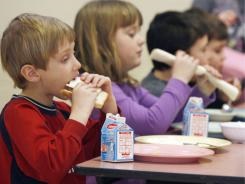
School districts across the country are revamping their menus to serve healthier fare, but most schools give students so little time to eat that they could be contributing unwittingly to the childhood obesity problem.
Children who bring their lunch would typically have a little more time to eat because they don't have to stand in line to get their meal, experts say.
Healthy food can take longer to eat, and research shows that wolfing down a meal in a hurry often means people eat more.
A new national survey by the School Nutrition Association shows elementary kids have about 25 minutes for lunch; middle school and high school students about 30 minutes. That includes the time students need to go to the restroom, wash their hands, walk to the cafeteria and stand in line for their meals.
Many students may have only about 10 to 15 minutes left to eat their meals, school nutrition directors say. But students should have at least 20 minutes to eat their lunch, the government recommends.
"It's a problem in a lot of districts. There's not a lot of time to get their food, sit down and eat their fill," says Helen Phillips, president of the School Nutrition Association, and senior director of school nutrition for Norfolk (Va.) Public Schools.
Many students feel rushed. The typical length of the lunch has been about the same since 2009, but it's shorter than in 2003 when kids got up to five more minutes. Children in some countries, such as France, get as long as one to two hours to eat lunch.
U.S. research shows that when people eat quickly, they consume more calories, enjoy the meal less and feel hungrier an hour later . This lunch-period dilemma comes at a time when about a third of children and adolescents — 25 million kids — are obese or overweight, government statistics show.
Almost 32 million kids eat the school lunch every day, and more than 11 million eat the breakfast served there. Overall, kids consume about 30% to 50% of their calories in the school meal programs.
The Healthy, Hunger-Free Kids Act of 2010 directs the U.S. Department of Agriculture to set new nutrition standards for all food served in schools, from lunchrooms to vending machines. Those standards are being developed now, but in the meantime, the school food service directors have already made lots of improvements, Phillips says. The new survey of 1,294 school nutrition directors from the School Nutrition Association found that most schools are offering fresh fruits and vegetables, whole grains, salad bars or entree salads, and fat-free and 1% milk.
But those kinds of foods often take more time to eat, Phillips says. "It takes more time to chew a whole apple than apple sauce. Eating an entree salad takes longer than eating a cheeseburger or chicken nuggets, because of the crunching and chewing of the raw vegetables." Sometimes kids eat their favorite foods first, and if they run out of time, those vegetables may land in the trash, she says.
Children who bring their lunch would typically have a little more time to eat because they don't have to stand in line to get their meal, she says. Whether or not it's enough time depends on the child and the length of the period. "The younger elementary kids tend to eat slowly."
The pressure of all the different academic demands affects the lunch schedules, Phillips says, so food service directors work with principals to make sure lunch hours are staggered so everyone is served quickly.
Many factors come into play when determining lunch periods, including building size, the number of serving lines, the seating in the cafeteria and the number of students coming to the cafeteria at any given time, she says.
Taylor adds: "I don't know if there is a perfect answer. Every building is different, every principal is different."
When people look back on the childhood obesity epidemic in this country and wonder how it spiraled out of control, they may blame the way kids were rushed to eat too fast, not just at school but at home, Taylor says.
"I think we have diminished the joy of sitting down and enjoying a meal. Now, the attitude is we should sit down and eat and get it over with."
Advice for parents:
Food service workers try to make it easy for kids to eat healthful foods. Parents can do the same when packing their lunches, they say.
For instance, Helen Phillips, senior director of school nutrition for Norfolk (Va.) Public Schools says her staff uses packaged fresh produce, such as baby carrots, apple slices, grapes and pineapple spears, so if a child runs out of time to eat the food at lunch, they can take the food with them in their backpack and eat them on their way home, at snack time or between classes, if the school allows that.
She recommends that parents cut most fruits and vegetables into small bite-size pieces for elementary children. “Elementary kids are often missing their front teeth and can’t easily bite into an apple or peach.”
Sometimes kids this age have a hard time manipulating the straws into their juice or milk boxes so it may be easier for them if parents choose a reusable containers with a pullup spout, she says.

Do you put extra hours in at work? Do you pick up extra shifts to generate overtime pay? Does the ever-growing pile of work on your desk cause you to stay late? Do you cut yourself short on sleep because of the pressures and demands of work?
If you do, you're like plenty of other working adults who are logging long hours, coping with work-related stress, and generally not getting enough rest. Overwork and little sleep can affect every aspect of our lives, from relationships, job performance and daily well-being to our fundamental health. A new study suggests that difficult and demanding work schedules also can contribute to obesity.
Researchers at the University of Maryland School of Medicine investigated the association between obesity and work schedules among 1,700 women nurses. Among the nurses in the study, 700 were determined to have unfavorable, or adverse, work schedules. The remaining 1,000 nurses were considered to have favorable work schedules. Researchers then examined the incidence of obesity among each group, and factors related to health behaviors, home demands, and work demands that might contribute to obesity. They found a majority of nurses were overweight or obese, and that work schedules appeared to influence the risk factors that contributed to weight problems.
Nursing is a demanding and high-stakes profession. While nurses are on the front lines of caring for patients' health and well-being, many are also likely to be working long hours, working evenings and overnight, or on schedules that rotate between day and night. In this regard, nurses are like the millions of Americans who are employed in shift work -- jobs that require workers to keep irregular schedules, which often require them to work during nighttime hours and to sleep during some portion of the day.
Shift work poses a number of well-documented challenges to health and to sleep. Shift workers are more likely than regular workers to suffer from disrupted and low sleep. They are also at elevated risk for chronic diseases such as diabetes. Shift work is common among jobs that involve public health and public safety, from police and firefighters to transportation workers, doctors, EMTs, and yes, nurses.
We also know a lot about the connection between the lack of sleep and weight problems. Not getting enough sleep causes hormonal changes that stimulate appetite. Being short on sleep prompts changes in the brain that make junk food even more attractive than it already is. Sleep deprivation lowers metabolism and diminishes the judgment and willpower necessary to make smart food choices. Sleeping less often translates into weighing more, over the long term.
We all have different work demands, different schedules, and different challenges related to our jobs. One thing we have in common? To the extent that our work conditions are interfering with our sleep, they may also be negatively affecting our weight.
VOCABULARY:
Shift: (the period of time worked by such a group-a group of workers who work for a specific period)
Overtime pay: pago por horas extraordinarias
Schedule: a list of tasks to be performed, esp within a set period. Timetable (horario, programa, plan)
High-stakes : used to describe a situation that has a lot of risk and in which someone is likely to either get or lose an advantage, a lot of money, etc.
In this regard: a este respecto, en este sentido
Shift work: trabajo por turnos
Prompt: (cause) dar pie a, provoca
Disrupted sleep: perturbación del sueño, sueño interrumpido.
Deprivation: being without ( carencia, privación)
TOO FAT TO FLY? DEALING WITH PASSENGERS OF SIZE (ARTICLE)
Discussing overweight passengers is like discussing politics or religion around the Thanksgiving dinner table with family: generally not a good idea.
When I saw the picture above, though, I felt compelled to address the issue. The picture you see was allegedly taken by an American Airlines flight attendant. Since bins are open and people are standing up, it appears it was taken during boarding.
I think we can all agree that allowing a passenger to protrude halfway into the aisle is clearly a safety violation. I also think it is safe to assume that the passenger was re-seated before takeoff to a row with an open middle seat.
Most U.S. airlines, including United and American, will not charge passengers of size (POS) for an extra seat as long as there are other open seats on the plane. I support this policy because I see no reason to castigate a POS further, especially when obesity is not always wholly dependent on lifestyle choice.
The problem arises when a flight is full and an airline is left with the choice of letting a POS literally occupy 1.5-2 Economy seats by allowing the arm rest to stay up and squeezing the other passengers in the row or having to VDB or even IDB a passenger to accommodate the POS. In such cases, I think an airline must give the POS the choice of stepping off the flight and waiting for the next one with an extra seat or paying for an extra ticket, perhaps at a lower cost.
Some posit that airline seats are too small and POS have no other alternatives. I disagree. United offers Economy Plus and First Class on most mainline domestic flights and Economy Plus, Business, and First Class on most international flights. Furthermore, it is not like airlines can easily (or even not so easily) install couches or rotund lazy boy recliners in their planes. To mandate that airlines compromise and dismantle a well-planned seating arrangements to accommodate a tiny sliver of the flying public is no more reasonable than arguing that an airline must make half-size seats available to compact people and only charge half-price for them.
Another analogy might be passenger baggage. Are bigger passengers allowed a higher weight allowance on checked bag? Of course not. They pay the same price as others and must abide by the same weight limits. Why should it be any different with onboard seating?
In some cases, like the picture above, any airplane seat (short of Singapore's A380 suites) would likely be too small for the passenger. In such cases, I believe a carrier should reserve the right to refuse passage on the grounds of passenger safety--both for the POS and others.
Am I missing something? How do you propose airlines deal with POS? Unfortunately, it is a growing problem in America. No pun intended.